Summary
 The University of Puerto Rico at
Mayagüez (UPRM) has established, through NASA Grant number NCC5-340, the Partnership for
Spatial and Computational Research (PaSCoR). The main goal of this 5-year project is to strengthen
academic programs and integrate research at the undergraduate level in various
science, math and engineering/technology (SMET) disciplines, following the
strategy of the Learning Factory model implemented by the NSF Manufacturing
Engineering Education Partnership. PaSCoR program is outcomes-based and student
centered, focused on hands-on learning activities provided throughout the
student’s academic career.
The University of Puerto Rico at
Mayagüez (UPRM) has established, through NASA Grant number NCC5-340, the Partnership for
Spatial and Computational Research (PaSCoR). The main goal of this 5-year project is to strengthen
academic programs and integrate research at the undergraduate level in various
science, math and engineering/technology (SMET) disciplines, following the
strategy of the Learning Factory model implemented by the NSF Manufacturing
Engineering Education Partnership. PaSCoR program is outcomes-based and student
centered, focused on hands-on learning activities provided throughout the
student’s academic career.
 The
program’s outcomes will be a SMET graduate that is knowledgeable of the
technology and applications of remote sensing (RS) and geographical information
systems (GIS), and, possesses the necessary skills either to enter graduate
school or becomes a professional in these areas with success. The program also
aims at developing values such as diversity, teamwork, global awareness and
communication. PaSCoR goals will be achieved through five tasks, namely: 1) curriculum development, 2) undergraduate research &
student mentoring, 3)
industry collaboration, 4)
outreach, and 5)
assessment.
The
program’s outcomes will be a SMET graduate that is knowledgeable of the
technology and applications of remote sensing (RS) and geographical information
systems (GIS), and, possesses the necessary skills either to enter graduate
school or becomes a professional in these areas with success. The program also
aims at developing values such as diversity, teamwork, global awareness and
communication. PaSCoR goals will be achieved through five tasks, namely: 1) curriculum development, 2) undergraduate research &
student mentoring, 3)
industry collaboration, 4)
outreach, and 5)
assessment.
Students from the following SMET departments at UPRM will be able to
earn a certificate in RS/GIS upon completion of 12 credit-hours in course work,
6 credit-hours in undergraduate research and a summer internship: Agricultural
Sciences, Biology, Geology, Electrical & Computer Engineering, Civil
Engineering, and Mathematics. Courses and resources are open to all SMET student on Campus. Currently, there are eight (8) faculty
members involved in student mentoring and course innovation/development, more
than 30 students engaged in undergraduate research and more than 750 students
taking RS/GIS interdisciplinary courses. NASA site visitors have recognized
this project as a model program in the
Purpose
 The purpose of
PaSCoR program is to provide minority institutions the opportunity to continue
their
undergraduate research
projects sponsored by NASA and its tradition of excellence by improving their
academic infrastructure in Mathematics, Science, Engineering and Technology
(SMET).
The purpose of
PaSCoR program is to provide minority institutions the opportunity to continue
their
undergraduate research
projects sponsored by NASA and its tradition of excellence by improving their
academic infrastructure in Mathematics, Science, Engineering and Technology
(SMET).
PaSCoR provides the
opportunity to create the environment for multidisciplinary training bringing
together an extensive number of faculties (SMET). Also, PaSCoR will train a
great number of students and prepare them to deal with the goals of the next
generation of scientists and engineers.
Curriculum Development
PaSCoR combines curriculum
revitalization with coordinated opportunities for application and hands-on
activities. Ten new courses will be created at the ECE Department, Mathematics,
Geology and Agricultural Sciences. In addition seven courses should be revised
at these departments to include concepts and applications of remote sensing and
GIS. The courses to be developed and those to be revised will contain and
balance both content with "soft" skills such
as problem-solving, communication and teamwork. The interdisciplinary
curriculum will consist of a continuous progression of courses spanning the
student's entire academic career.
Undergraduate Program Option Attributes
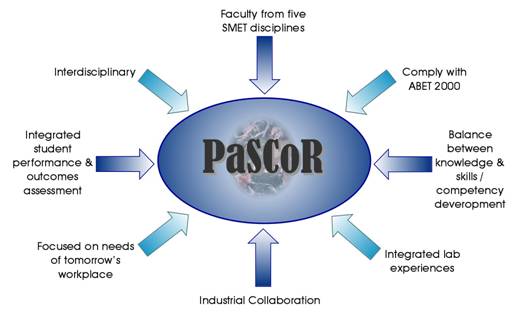
Courses' Main Focus
·
Practiced-based,
hands-on educational experience
·
Balance
traditional scientific & mathematical principles with practical experiences
·
Development
of skills
·
Compliance
with ABET 2000
Paradigm...
· Education should increase both knowledge & skills, and promote new attitudes & values.
· Educational process should be designed to maximize & enhance the student's knowledge base & skills and develop an individual who is a self-learner using the computers & thinks critically.
Fliers and Brochures
PaSCoR Flier English Version PaSCoR Brochure Spanish Version 1
PaSCoR Brochure English Version PaSCoR Brochure Spanish Version 2
Annual Reports