|
Pan-American Seminar and Workshop on the Interface between Automobile Traffic Networks
under Dynamic Traffic Assignment and Bus Rapid Transit Systems
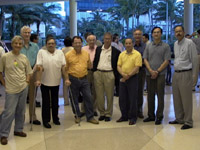 The "Pan-American Seminar and Workshop on the Interface between Automobile Traffic Networks under Dynamic Traffic
Assignment and Bus Rapid Transit Systems", organized by CoHemis for UPR-Mayaguez and its Department of Civil Engineering
was held on March 20-22, 2003 at the Caribe Hilton Hotel, San Juan, Puerto Rico. It was sponsored by National Science
Foundation (NSF) and the Federal Transit Administration (FTA), with the collaboration of the Puerto Rico Highway and
Transportation Authority. Since its objective was to foster linkages between both disciplines mentioned in the event's
title, and these topics have been developed in different Americas, the sponsors provided funds for inviting researchers,
engineers, system operators and decision-makers from both continents. Several interesting benefits from DTA-BRT linkages
were identified during the two full days of sessions.
The "Pan-American Seminar and Workshop on the Interface between Automobile Traffic Networks under Dynamic Traffic
Assignment and Bus Rapid Transit Systems", organized by CoHemis for UPR-Mayaguez and its Department of Civil Engineering
was held on March 20-22, 2003 at the Caribe Hilton Hotel, San Juan, Puerto Rico. It was sponsored by National Science
Foundation (NSF) and the Federal Transit Administration (FTA), with the collaboration of the Puerto Rico Highway and
Transportation Authority. Since its objective was to foster linkages between both disciplines mentioned in the event's
title, and these topics have been developed in different Americas, the sponsors provided funds for inviting researchers,
engineers, system operators and decision-makers from both continents. Several interesting benefits from DTA-BRT linkages
were identified during the two full days of sessions.
The metropolitan areas of the Americas are continuously looking for efficient and effective ideas to improve the 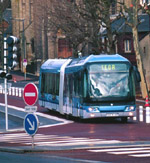 mobility of their citizens. One of these ideas, pioneered in Curitiba, Brazil, is Bus Rapid Transit, a system of buses
moving on exclusive highway lanes and tendered by passenger stations. BRT has been operating for years in various cities
of South America, and it has proved able to deliver a level of service only slightly below heavy rail transit at a fraction
of the cost. In addition, BRT causes minimum social and economic disruptions in the construction phase, which is also very
much shorter, and increases the benefits provided by the existing infrastructure resources. Several cities around the
world, guided by the FTA in the case of the United States, are adopting the idea.
mobility of their citizens. One of these ideas, pioneered in Curitiba, Brazil, is Bus Rapid Transit, a system of buses
moving on exclusive highway lanes and tendered by passenger stations. BRT has been operating for years in various cities
of South America, and it has proved able to deliver a level of service only slightly below heavy rail transit at a fraction
of the cost. In addition, BRT causes minimum social and economic disruptions in the construction phase, which is also very
much shorter, and increases the benefits provided by the existing infrastructure resources. Several cities around the
world, guided by the FTA in the case of the United States, are adopting the idea.
The development and implementation of Intelligent Transportation Systems (ITS-mainly information technologies for
drivers) have led to the development of new modeling tools for the prediction and evaluation of alternatives that take
into account the dynamics of transportation systems. These tools are known as Dynamic Traffic Assignment (DTA), and they
can help ITS subsystems to reduce congestion while improving productivity, safety and the environment. However, most
existing DTA models are limited to the dynamics of automobile traffic in urban highway systems, and do not integrate
information on BRT and other transit strategies.
Several benefits of BRT-DTA linkages were identified in the workshops. If DTA-type models are adapted to BRT, and
real-time traffic information and corresponding DTA projections are fed to BRT operators, then the latter can foresee
changes in demand and have an adequate and efficient number of vehicles in service without having to react to
congestion-induced delays. On the other hand, if BRT information is fed to DTA traffic models, then intermodal effects
and alternatives can improve traffic management as well as the overall effectiveness of ITS on urban transportation.
The more time it takes to develop such linkages, the longer will urban transportation be delayed in improving mobility
and efficiency in metropolitan areas. Operating independently, BRT and automobile traffic using ITS strategies modeled
under DTA would be competing with each other.
The stated objectives of the event were to assess the respective state-of-the-art and the state-of-the-practice and
suggest research priorities in the integration of BRT and DTA-based automobile traffic systems in the Americas. It 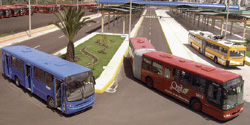 brought together leading researchers and practitioners from north and south to exchange ideas and information and to
join efforts concerning the integration of BRT and other transit systems with automobile traffic networks under DTA and
other ITS systems. The participants came from: Brazil, United States, Colombia, Chile, Ecuador, Mexico, Dominican Republic,
United Kingdom, Venezuela and Puerto Rico.
brought together leading researchers and practitioners from north and south to exchange ideas and information and to
join efforts concerning the integration of BRT and other transit systems with automobile traffic networks under DTA and
other ITS systems. The participants came from: Brazil, United States, Colombia, Chile, Ecuador, Mexico, Dominican Republic,
United Kingdom, Venezuela and Puerto Rico.
The seminar-workshop was organized by: Dr. Didier Valdés-Díaz, UPRM-Civil Engineering, Scientific Director;
Dr. Luis F. Pumarada-O'Neill, Organizer; and Mrs. Ileana Rodriguez, Coordinator of the CoHemis Center. Local attendees
included graduate and undergraduate transportation students, as well as agency officials and transit experts. The opening
ceremony featured Dr. Fernando Fagundo, Secretary of Transportation and Public Works, and Dr. Jack Allison, Executive
Director of the Highway and Transportation Authority. A group of transportation students under the supervision of
Dr. Didier Valdés are working on the seminar's proceedings.
For more information one may inquire at dvaldes@ce.uprm.edu and visit the event's
home page, ece.uprm.edu/cohemis/brt/, which includes some of the presentations, photos and other information.
Photo Gallery
|